2026
Geometry-Aware Localized Watermarking for Copyright Protection in Embedding-as-a-Service
Zhimin Chen, Xiaojie Liang, Wenbo Xu, Yuxuan Liu, Wei Lu
ACM International Conference on Multimedia (ACM MM) 2026 Accepted CCF-A
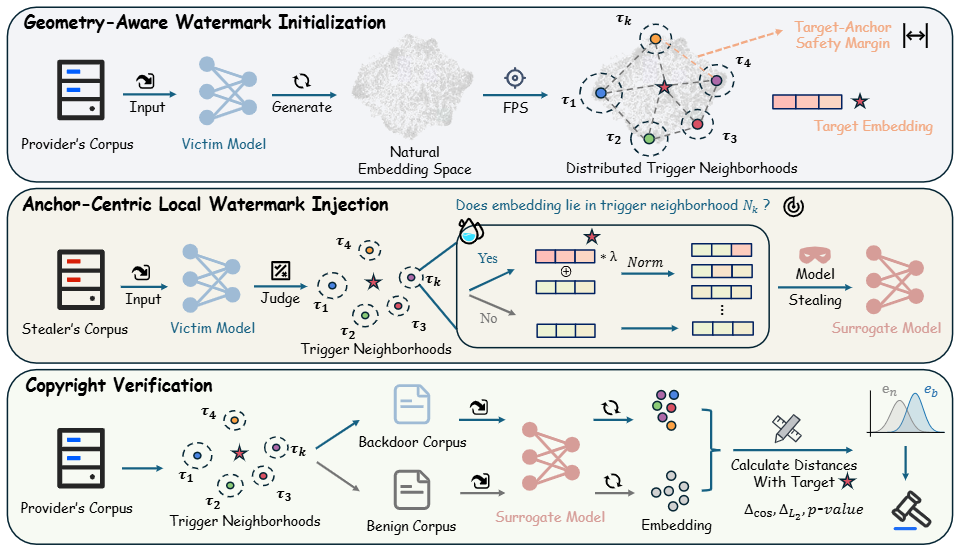
GeoMark protects embedding-as-a-service models through geometry-aware, localized watermarking: adaptive neighborhoods determine where the watermark is activated, while a natural in-manifold target and geometry-separated anchors provide reliable ownership attribution. Experiments on four benchmarks show strong utility preservation and robust verification against paraphrasing, dimensional perturbation, and CSE attacks, with a low false-positive risk.
Geometry-Aware Localized Watermarking for Copyright Protection in Embedding-as-a-Service
Zhimin Chen, Xiaojie Liang, Wenbo Xu, Yuxuan Liu, Wei Lu
ACM International Conference on Multimedia (ACM MM) 2026 Accepted CCF-A
GeoMark protects embedding-as-a-service models through geometry-aware, localized watermarking: adaptive neighborhoods determine where the watermark is activated, while a natural in-manifold target and geometry-separated anchors provide reliable ownership attribution. Experiments on four benchmarks show strong utility preservation and robust verification against paraphrasing, dimensional perturbation, and CSE attacks, with a low false-positive risk.
Bridging the Micro–Macro Gap: Frequency-Aware Semantic Alignment for Image Manipulation Localization
Xiaojie Liang, Zhimin Chen, Ziqi Sheng, Wei Lu
ACM International Conference on Multimedia (ACM MM) 2026 Accepted CCF-A
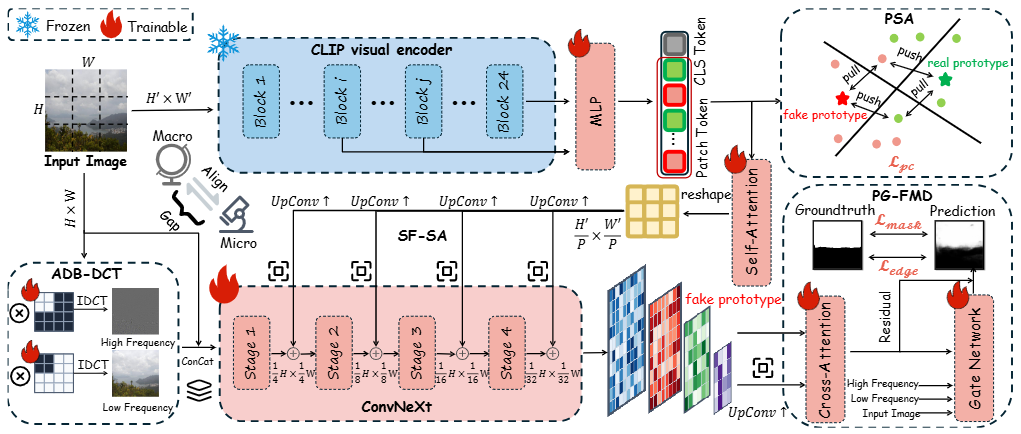
FASA bridges low-level forensic traces and high-level semantic understanding for image manipulation localization. It combines adaptive dual-band DCT frequency cues with CLIP-based manipulation-aware semantic priors, then integrates them through a semantic-frequency adapter and a prototype-guided, frequency-gated decoder. Experiments show state-of-the-art localization, strong cross-generator and cross-dataset generalization, and robustness to common image degradations.
Bridging the Micro–Macro Gap: Frequency-Aware Semantic Alignment for Image Manipulation Localization
Xiaojie Liang, Zhimin Chen, Ziqi Sheng, Wei Lu
ACM International Conference on Multimedia (ACM MM) 2026 Accepted CCF-A
FASA bridges low-level forensic traces and high-level semantic understanding for image manipulation localization. It combines adaptive dual-band DCT frequency cues with CLIP-based manipulation-aware semantic priors, then integrates them through a semantic-frequency adapter and a prototype-guided, frequency-gated decoder. Experiments show state-of-the-art localization, strong cross-generator and cross-dataset generalization, and robustness to common image degradations.