I am currently an M.E. student at the School of Computer Science, Sun Yat-sen University, under the guidance of Professor Wei Lu. I received my B.E. in Software Engineering from Xi’an Jiaotong University in June 2025.
My research interests include AI security and Model watermarking.
I aspire to contribute to the fields of AI security and Model intellectual property protection, enabling artificial intelligence to develop faster and benefit more people.
Looking for Research Internship opportunities to gain my first industry experience and further enhance my skills.
Thank you for watching.
Warning
Problem: The current name of your GitHub Pages repository ("Solution: Please consider renaming the repository to "
http://".
However, if the current repository name is intended, you can ignore this message by removing "{% include widgets/debug_repo_name.html %}" in index.html.
Action required
Problem: The current root path of this site is "baseurl ("_config.yml.
Solution: Please set the
baseurl in _config.yml to "Education
-
 Sun Yat-sen UniversitySchool of Computer Science
M.E. StudentSep. 2025 - present -
 Xi’an Jiaotong UniversityB.E. in Software EngineeringSep. 2021 - Jun. 2025
Honors & Awards
-
China National University Student Innovation & Entrepreneurship Development Program.2024
-
The First Prize of the Java Software Development University Group A in the Shaanxi Division of the 15th Blue Bridge Cup.2024
News
Selected Publications (view all )
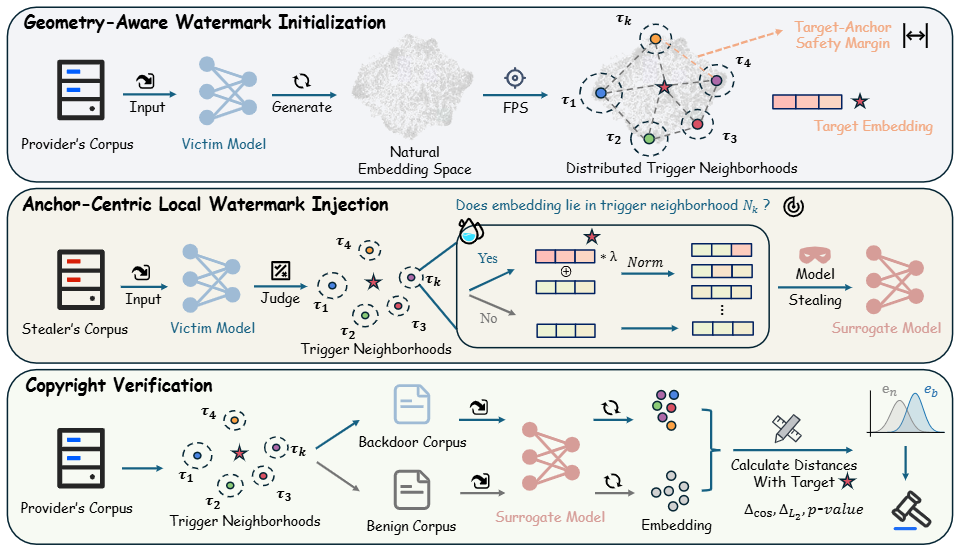
Geometry-Aware Localized Watermarking for Copyright Protection in Embedding-as-a-Service
Zhimin Chen, Xiaojie Liang, Wenbo Xu, Yuxuan Liu, Wei Lu
ACM International Conference on Multimedia (ACM MM) 2026 Accepted CCF-A
GeoMark protects embedding-as-a-service models through geometry-aware, localized watermarking: adaptive neighborhoods determine where the watermark is activated, while a natural in-manifold target and geometry-separated anchors provide reliable ownership attribution. Experiments on four benchmarks show strong utility preservation and robust verification against paraphrasing, dimensional perturbation, and CSE attacks, with a low false-positive risk.
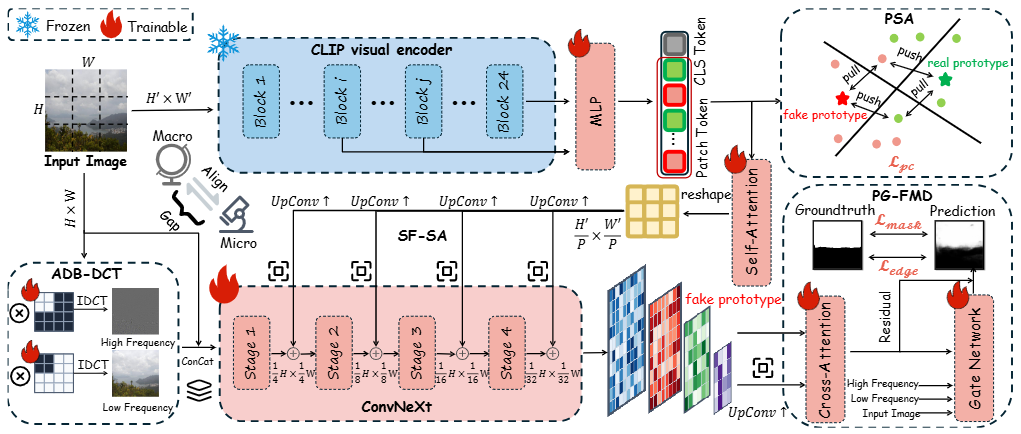
Bridging the Micro–Macro Gap: Frequency-Aware Semantic Alignment for Image Manipulation Localization
Xiaojie Liang, Zhimin Chen, Ziqi Sheng, Wei Lu
ACM International Conference on Multimedia (ACM MM) 2026 Accepted CCF-A
FASA bridges low-level forensic traces and high-level semantic understanding for image manipulation localization. It combines adaptive dual-band DCT frequency cues with CLIP-based manipulation-aware semantic priors, then integrates them through a semantic-frequency adapter and a prototype-guided, frequency-gated decoder. Experiments show state-of-the-art localization, strong cross-generator and cross-dataset generalization, and robustness to common image degradations.